
Case Study: One Solution Pattern for Digital Police Services Across Regions
From Barito Kuala to Bogor, residents' needs for police services turn out to be similar. Here is how we built Polres service apps with a shared core and local customisation.
This article was translated from Bahasa Indonesia with AI assistance and reviewed by our team.
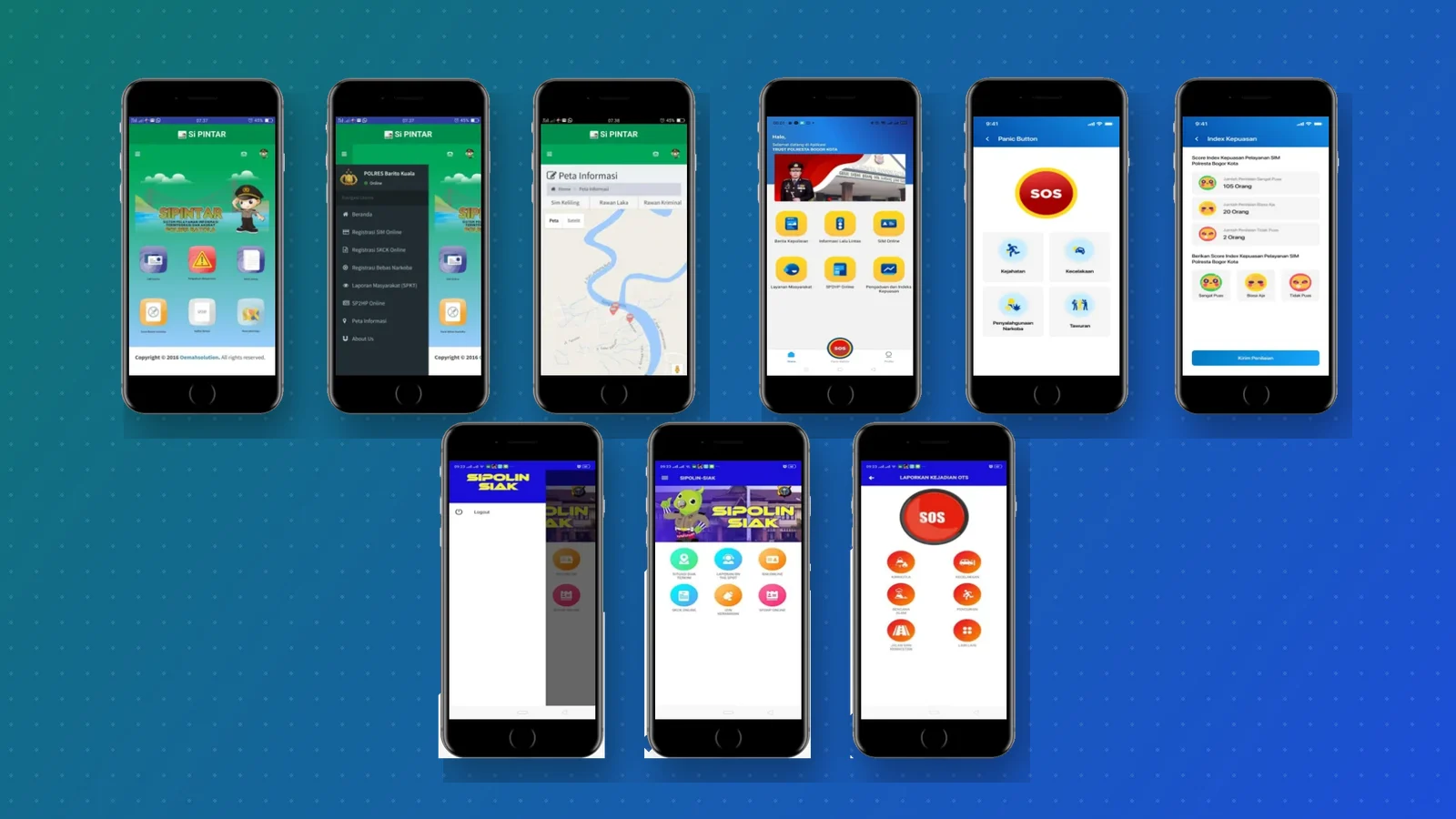
For several years now, Oemah Solution Indonesia has been building police service applications for a number of Polres (district police) and regions, including SI PINTAR (Polres Barito Kuala), I-LINK (Polres Rokan Hilir), SIPOLIN (Polres Siak), I-POLICE (Polres Seluma), TRUST (Polresta Bogor Kota), and LRC — Lamtim Respon Cepat (East Lampung).
Every region has its own name, identity and priorities. Yet once their needs were mapped out, the pattern turned out to be very similar.
Recurring problems
- Residents have to come in person to arrange a driving licence (SIM), a police clearance certificate (SKCK) or a public event permit, often just to register or to queue.
- Complaint channels are limited. Public reports arrive through many routes that are not properly documented.
- Emergencies demand a fast response, yet residents do not always know whom to contact.
- Information is scattered — from mobile SIM service schedules and accident-prone locations to news about Polres activities.
- Case progress is hard for reporters to track.
The solution pattern: the same core, local configuration
Instead of building from scratch for every region, we put together a set of service modules that can be selected and adapted:
| Module | Example implementations |
|---|---|
| Online SIM registration & queueing | SI PINTAR, I-LINK, SIPOLIN, I-POLICE, TRUST, LRC |
| SKCK registration | SI PINTAR, SIPOLIN, TRUST, LRC |
| Public reports / complaints | SI PINTAR, I-LINK, SIPOLIN, TRUST, LRC |
| Panic button / emergency call | SIPOLIN, I-POLICE, TRUST, LRC |
| Online SP2HP (investigation progress) | SI PINTAR, TRUST |
| Public event permits | SIPOLIN, TRUST |
| Map of mobile SIM services, accident-prone and crime-prone areas | SI PINTAR |
| Traffic accident & traffic information | I-LINK, TRUST |
| News & activity information | I-LINK, I-POLICE, TRUST, LRC |
Each Polres then chooses the modules its residents need most, adds region-specific services — for example, information on Polri recruitment in SIPOLIN or the Public Satisfaction Index in TRUST — and displays its own local identity.
Why this approach works
- Faster to launch. Proven modules can be reused, so development time is focused on each region's specific needs.
- More consistent quality. Security and usability improvements made to one module can be applied to other apps.
- Still feels local. Names, colours and service choices are customised so the app is accepted as the local Polres's own service.
Looking ahead: interoperability
Presidential Regulation Number 82 of 2023 on the Acceleration of Digital Transformation and the Integration of National Digital Services designates a number of priority SPBE (Electronic-Based Government System) applications, including integrated police services, such as the issuance of SIMs and public event permits. The government is also preparing INA Digital as a platform to bring these priority services together.
For regional service applications, this direction means that a modular, API-based design is becoming ever more important: clearly separated modules are easier to integrate with, or redirect to, national services when the time comes, without having to rebuild the entire application.
Key lesson
Public service needs across regions are often more alike than they appear. Mapping recurring patterns, building reusable modules and leaving room for local customisation is an efficient way to deliver high-quality digital services — while also being ready to connect with the national digital service ecosystem.
Sources & references
This article is a summary and interpretation by the Oemah Solution team of the sources below. Refer to the original sources for full details and context.